Best intentions go astray because software development organizations are non-linear adaptive systems. They can’t be controlled directly, but you can influence the system. We show you how.
Have you ever seen an attempt at process improvement backfire? If so, you’re not alone. Back in 2001 Elisabeth wrote about a case where better testing led to worse quality but that example is hardly unique. Examples abound. An organization trying to tighten up release timelines ended up with ever-increasing planning horizons. Yet another organization that rolled AI tooling to speed up development ended up slowing down. Best intentions go astray because software development organizations are non-linear adaptive systems. Attempting to control outcomes as a straightforward chain of cause and effect doesn’t work. When you face a big challenge—poor quality releases, slow delivery, or missed commitments—there is no single dial to turn. You can influence the system, but first you have to understand how it works. In this talk we show you how to see your context as a system, and reason about it so you can find the possibly counter-intuitive approaches to solve hard problems.
Book: Signals & Levers, systems thinking tools to unblock for delivering systems
about systems thinking
Paper: Better Testing Worse Quality, Elizabeth Hendrickson
we were finding more bugs, most of the bugs were noise, not signals
they poked the system and the system poked back
About Systems
A system is a set of interrelated parts that does something
it has these properties:
- the whole is indivisible
- parts are interdependent - when we change one part the others adapt, ripple effects
- systems are fractal - the way the team interacts is a function of the system
investment in automation - relentless prioritisation - fast feedback - team autonomy
Levers are choices or decisions you can make to cause a shift in the system
Signals are observable characteristics or attributes of the system that tell you something about the way the system works
Why did that happen?
differing perspectives
when someone pulls a lever they react on the signals they get, but not everybody sees the same signals
Sales: revenue - daily active users - competitor rankings - customer churn
Testers: bug counts - pull requests - cycle time - dependencies - test coverage
Operations: incident count - incident duration - deploy frequency - mean time to recover
all the signals effect each other
customer churn
     |
  revenue
     |
  pressure
     |             |
  tech debt    bug counts
     |
  incident count & duration
     |
  customer churn
=> adaptive systems
acting where pain is caused -> not where it is observed, the cause is something else
levers operate in context
past choices determine current options context is the aggregated result of past decisions
your problems are not unique, your context is
variations on the Mythical Man-Month curve depending on context
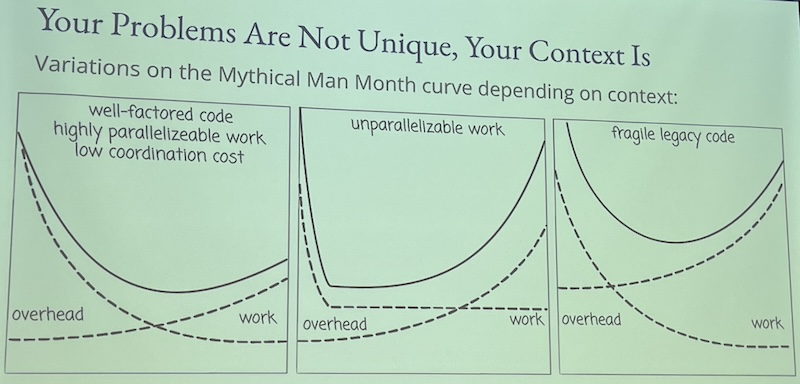
- well-factored code, highly parallelisable work, low coordination cost
- unparallelisable work
- fragile legacy code
Understand Context in Concrete Teams dimensions of context
- capacity: 1 full time member, 3 split
- risk: few tests, fragile code
- execution
- adaptibility: informal process
- trust: high blame, political
- economics: budget pressure
mixing contexts: capacity vs execution, need more people to go faster is an execution problem, not a capacity problem
context changes constantly
solving the wrong problem
when having an execution problem and trying to solve it with capacity will make it worse
flying buttress is a process or policy designed to shore up another process or policy that can’t hold on its own
examples:
- pre- pre- meetings to prepare the meeting
- a formal expediting process to bypass process overhead
- overstandardisation
problem, not solution
perceived state: standing on one side of a ravine
problem: how to get to the other side (not the lack of a bridge, or lack of a helicopter, or lack of a giant pet eagle)
desired state: be on the other side of the ravine
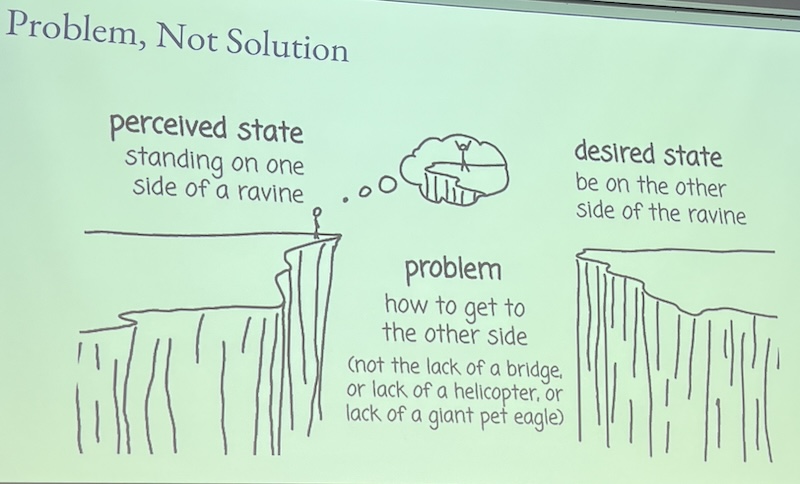
we don’t have enough tests is not the problem
Now What?
first understand the levers in context
testers already do systems thinking, they ask the right questions, holistic view
policy & culture levers
when policies are at odds, culture wins
culture: the unwritten stuff, the unwritten norms of behaviour
the signals, the rituals are expressions of culture
regardless of title, we have levers, we can share the signals we observe
ex. meeting, it seems we already have this conversation before, why? maybe something else is happening