The world around us are getting ever increasingly hard to understand and predict in the way that we are used to. Simply taking a system apart and studying the elements and making useful models out of them seems to fail more often than not. Systems thinking is by many regarded as an essential tool for dealing with this kind of complexity, where unpredictability and ambiguity is the name of the game. The thing is that even though systems thinking is regarded as a new science, it is not an easy task to get a hang of. Not only is it mind-bending and frequently counter-intuitive, there are also numerous different schools of thought that frames things very differently and are useful for different things.
the deep, deep rabbit hole that is Systems Thinking
thriving complexity: kids party at home
kids have the time of their life
but not how you planned it
you are into damage control
that’s why I started outsourcing this
A system is never the sum of its parts; its the product of their interactions
– Russell L. Ackoff
As system is more than the sum of its parts; it is an indivisible whole.
It loses its essential properties when it is taken apart.
– Russell L. Ackoff
An organization is a system and the performance of a system depends more on how its parts interact than on how they act when taken separately.
– Russell L. Ackoff
=> introduces the soft parts, the social part of socio-technical
Book: Ackoff’s Best: His Classic Writing on Management
Types of systems
- deterministic: parts -> no purpose; whole -> no purpose
- animated: parts -> no purpose; whole -> purpose
- social: parts: you are part of a team -> purpose; whole: team -> purpose
- ecological: parts -> purpose; whole -> no purpose
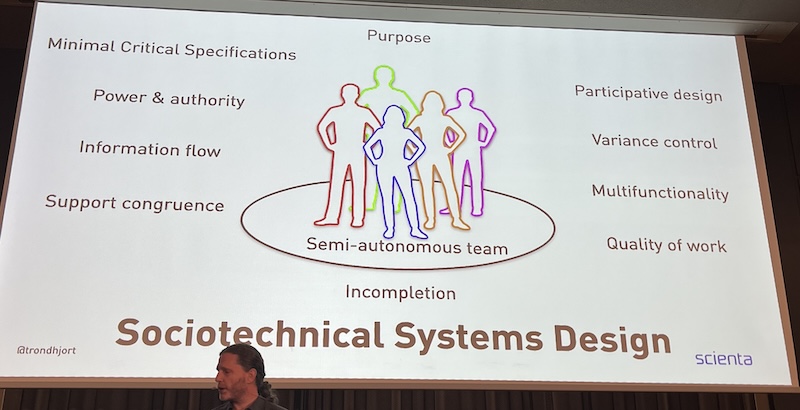
this is what defines agile, but in fact this was defined in the 60s
The perfect agile team has been thought of in the social sciences in the 60s => Sociotechnical Systems Design
people in an autonomous team have needs, they search for:
- elbow room
- variety
- continual learning
- meaningfulness
- mutual support and respect
- desirable future
again defined by social science in the 60’s
Complex Environment - Sociotechnical System
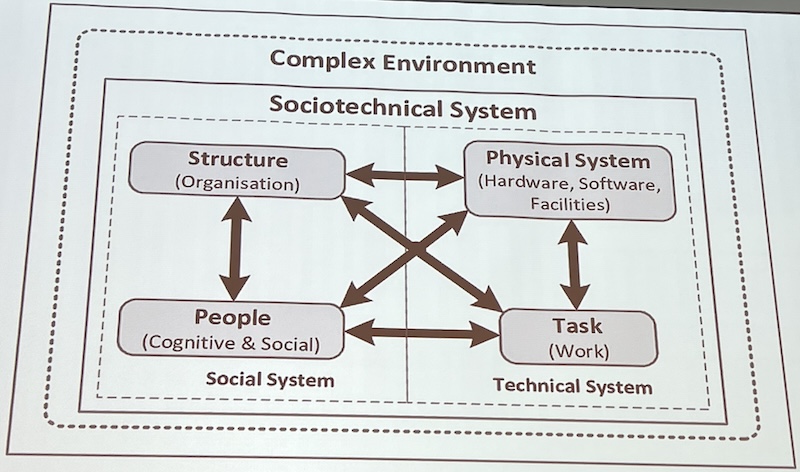
social and technical parts interact
Ackoff -> open systems theory
The biosphere includes both the individual and the environment, not as interacting parts, not as constituents which have an independent existence, but as aspects of a single reality which can be separated only by abstraction.
– Andras Angyal, 1941
a system and an environment cannot be separated
=> a system cannot be understood without its environment
=> you are taking away something very important when taking the environment away
the team is exposed to an environment, if you don’t know the environment, you cannot understand the team
what we often do is to create a closed system; we do that because it is easier to reason about that
System in two levels of environment
Merrelyn Emery
- the task environment
- the global environment
3 types of systems
- type II: placid clustered: dominant before the industrial revolution
- type III: disturbed reactive: in the industrial area until second world war < 1950
- type IV: turbulent: after world war II > 1950
DP1 and DP2
DP1: redundancy of parts
=> bureaucracy: every part does only one task
=> hierarchy: only the person at the top is responsible, all others are irresponsible
=> Taylorism
DP2: redundancy of functions
every part of the team need to be able to do more than one thing
Merrelyn Emery, The Current Version of Emery’s Open Systems Theory
fragility towards resilience
- Type II: placid clustered -> DP2
- Type III: disturbed reactive -> DP1
- Type IV: turbulent -> DP1 -> DP2
=> new DP2
DP1 vs new DP2
DP1: simple org with simple jobs: you don’t want to try to change things here -> fragile
new DP2: simple org with complex jobs -> resilient
de Guerre, Open Systems Theory and the Two-Stage Model of Active Adaptation
you have to move from hierarchy of individuals to a hierarchy of functions => no power hierarchy
STS design was intended to produce a ‘win-win-win-win’: human beings were more committed, technology operated closer to its potential and the organization performed better overall while adapting more readily to change in its environment.
– Pasmore et al
Emery: www.socialsciencethatactuallyworks.com
As soon as people are forced to compete, they have to look after their own interests an so self interest comes to dominate life in a DP1 structure. All the team building in the world cannot change this dynamic.
– Merrelyn Emery
=> competing is not helpful when we are trying to collaborate, we can try to spread knowledge, because now the power is on sharing, not in keeping it.
It is only when the people involved work out their own design that the necessary motivation, responsibility and commitment to effective implementation is present.
– Fred Emery & Merrelyn Emery, 1974
=> one does not simply impose designs